
Product
Concrete formwork blocks
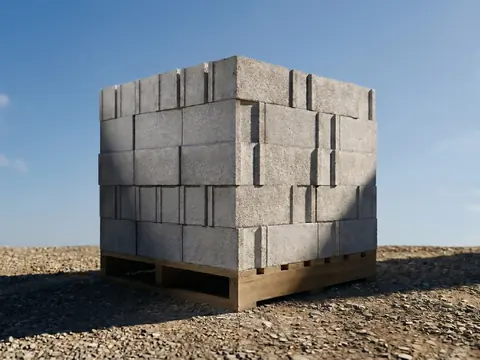
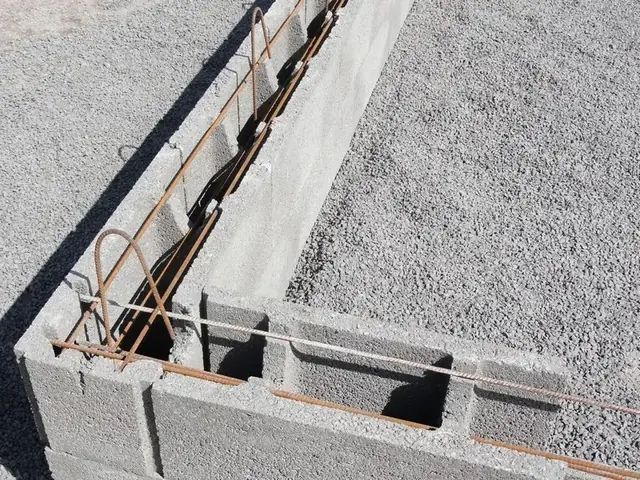
The GEP formwork block is an interlocking hollow block that acts as permanent formwork: dry-stacked, reinforced and filled with concrete, it behaves like a reinforced concrete wall. For load-bearing walls, retaining walls, foundations, swimming pools and fences.
Specifications
Two formats: standard block and end block.
| Material | Concrete |
|---|---|
| Dimensions | 20 × 20 × 50 cm |
| Blocks per m² | 10 |
| Blocks per pallet | 60 |
| Weight | 18 kg per block |
| Fill concrete | 110 l/m² |
| Recommended maximum height | 3.8 m |
Indicative values. For any use, refer to the construction drawings and applicable standards.
Uses
- Retaining walls
- Foundations
- Swimming pools
- Agricultural facilities
- Base walls
Benefits
- Time savings on site
- Suited to walls under heavy loads
- Dry laying and storey-height pouring
- Vertical interlocking joint, no mortar
- Good thermal insulation
Installation in 4 steps
Build the foundations
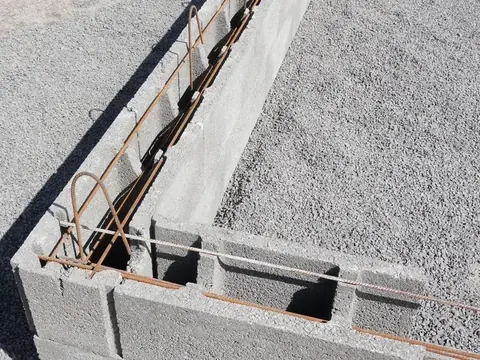
Concrete footing with vertical starter bars.
Lay the first course
Corner blocks first, then align the course on mortar.
Dry-stack
Interlock up to 6 courses, 1 m high.
Pour the concrete
Fluid C20/25 concrete up to mid-height of the top block.
Price and availability
Prices and stock are handled by the Comptoir GEP. Contact it for an up-to-date price, or request a quote for your project.
Frequently asked questions
What is a formwork block?
An interlocking hollow concrete block, dry-stacked, that acts as permanent formwork: once reinforced and filled with concrete, it forms a reinforced concrete wall.
How does it differ from a concrete block?
A concrete block is laid on mortar for standard masonry. A formwork block is dry-stacked then filled with reinforced concrete: it suits highly loaded walls such as retaining walls.
Which fill concrete?
Fluid C20/25 concrete, about 110 litres per m² of wall.
How many courses before pouring?
Up to 6 courses (1 m high), then pour up to mid-height of the top block.
Is it suitable for a swimming pool?
Yes, swimming pools are among the common uses of formwork blocks, along with retaining walls and base walls.